Know which target moves the disease.
Biostrome runs arrayed CRISPRi screens across patient-derived organoids, then ranks every hit by effect size, essentiality margin and tractability — in one workbench your biologists and chemists read the same way.
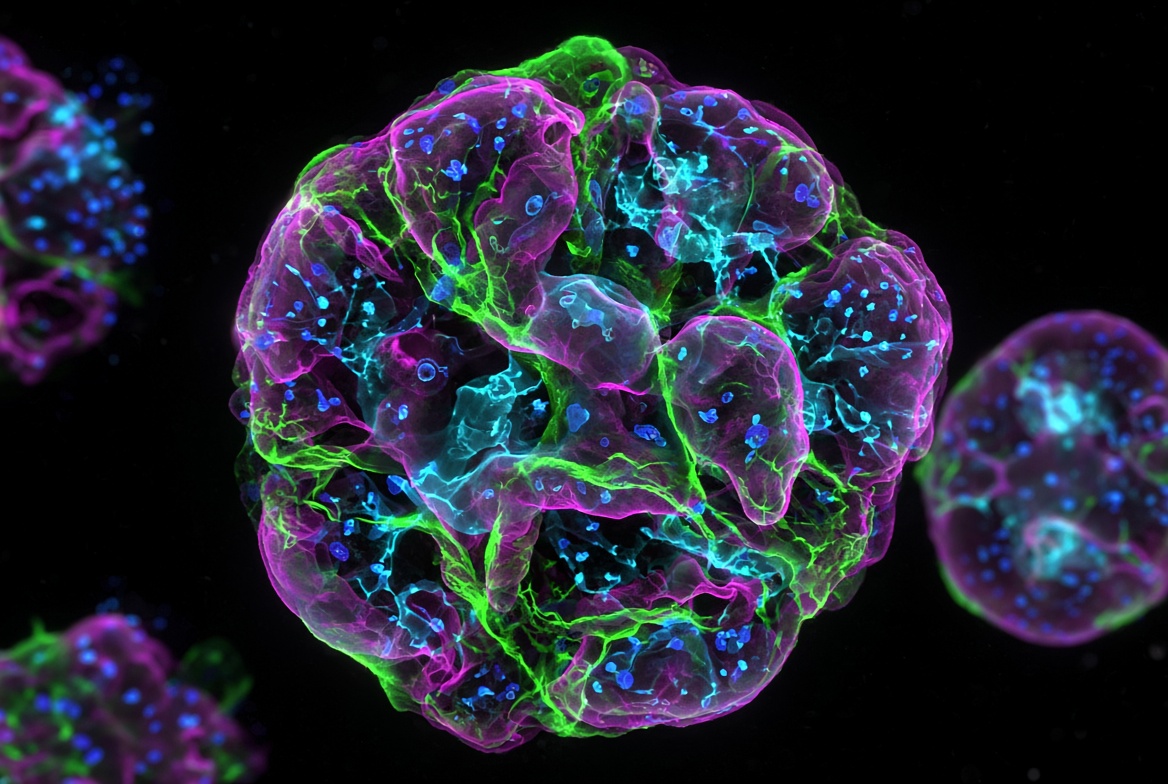
The workbench
One screen, read the same way by biology and chemistry.
| Target | Δ viability | Essentiality margin | Tractability | Call |
|---|---|---|---|---|
| SHOC2 | −68% | +2.4 σ vs. normal colon | Small molecule | Advance |
| PTPN2 | −54% | +1.9 σ | Small molecule | Advance |
| WRN | −49% | +3.1 σ (MSI-high only) | Small molecule | Watch |
| CPS1 | −31% | +1.2 σ | Degrader | Watch |
| RPL13A | −82% | −0.3 σ (pan-essential) | — | Filtered |
Every hit is scored against DepMap essentiality priors and a matched normal-tissue arm, so ribosomal and proteasomal noise never reaches a review meeting.
Pocket volume, known ligands, structural coverage and degrader precedent join each target automatically — pulled at hit-call time, not three weeks later.
Click any value to reach the raw image field, the guide sequence and the operator who ran the plate. Audit-ready for partner diligence.
The method
Model, perturb, deconvolute.
Model
Patient-derived organoids expanded across 12 lineages, each re-baselined by scRNA and morphology before a screen is allowed to start.
Perturb
Arrayed CRISPRi at three guides per gene, imaged at 0, 48 and 96 hours — arrayed, not pooled, so morphology and viability stay attached to a single gene.
Deconvolute
Hits are ranked against essentiality priors and matched normal arms, then annotated with chemistry tractability before anyone writes a program memo.
Pipeline
Programs from our own screens.
Updated Q3 2026
| Program | Target | Modality | Indication | Stage |
|---|---|---|---|---|
| BS-201 | SHOC2 | Small molecule | KRAS-mutant colorectal | Lead optimization |
| BS-118 | PTPN2 | Small molecule | Immune-cold solid tumors | IND-enabling |
| BS-076 | WRN | Small molecule | MSI-high colorectal | Discovery |
| BS-340 | CPS1 | Targeted degrader | LKB1-mutant NSCLC | Discovery |
| Partnered | PRMT5 (MTAP-del) | Small molecule | Undisclosed | Preclinical |
"The essentiality margin column is what killed three of our programs early. That is the whole value."
Careers
Wet lab and workbench, one team.
Our screeners and our software engineers sit in the same room and share the same on-call. 34 people in Cambridge, 11 in Basel.
See a real screen, not a slide.
Forty minutes with a Biostrome scientist, walking one live screen end to end — plate to program memo.